
Your First Trip to Japan and a Tokyo Street Kart Tour: Where Nervous English Speakers Tend to Struggle, and How to Avoid It
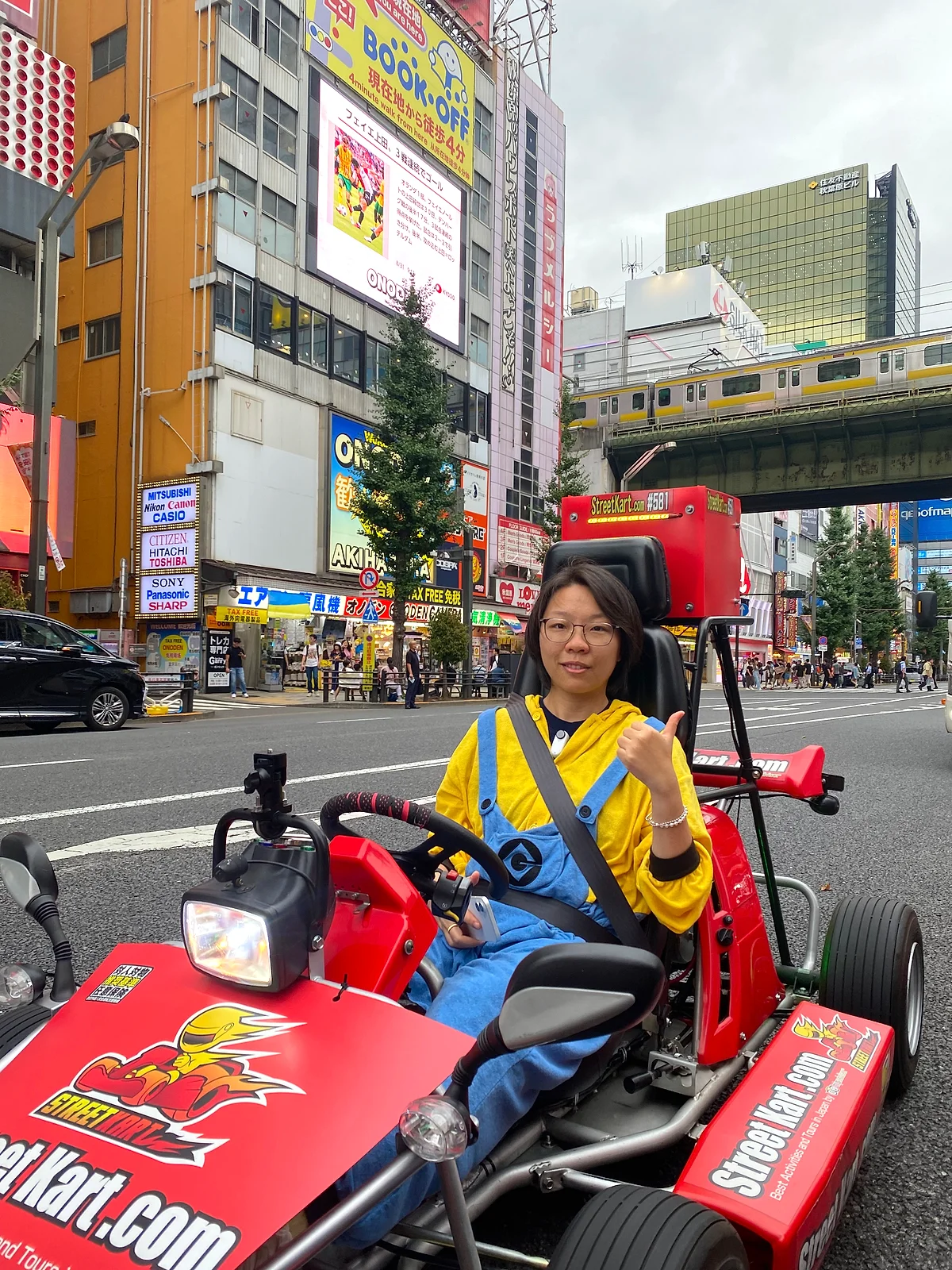
Your First Trip to Japan and a Tokyo Street Kart Tour: Where Nervous English Speakers Tend to Struggle, and How to Avoid It
"My English isn't that great... will I be okay?"
Have you ever been about to book a street kart tour in Tokyo and stopped right at that thought? I think a lot of people do. On your first trip to Japan you're figuring out everything as you go: the station signs, the way shop staff greet you, even how to reply to a message.
But here's the thing. Most of the worry about language comes from not knowing where you'll run into trouble. If you know ahead of time which moments are tricky, you can deal with most of them before the day of your tour. At least, that's what I believe.
So in this article, we'll go through the tricky moments in three stages: from booking to arriving at the shop, the briefing before you set off, and the drive itself. Let's go through them in order!
First, Let's Get One Thing Straight: The Website's Language and the Tour's Language Are Not the Same
The first pitfall actually comes before you even book.
The official Street Kart website is available in 22 languages. When you open the page and see your own language listed, it's a relief. But if you assume this means "they'll guide me in my language on the day!", you could be in for a panicked morning.
On the day of the tour, guidance is basically in English. Whether staff can speak Japanese or any other language depends on who is working that day, so it isn't guaranteed. The website's languages are for reading information in advance. The language on the day is a separate matter. Keep the two clearly apart in your mind.
So what should you do? The answer is simple: plan from the start on the tour being in English! The less confident you are in English, the more this mindset helps. If it really worries you, you can also get in touch before booking and ask. But since even that answer depends on the staff working that day, you'll feel more secure if you prepare some English anyway.
Here's something about Japan worth knowing. Tokyo's stations have plenty of English signs. At the same time, conversations at shops and counters are often in Japanese. "I can read the signs, but I freeze the moment someone speaks to me." This gap is something first-time visitors are often surprised by.
And if you come from a country that uses Chinese characters, be careful. Because you can roughly understand the signs, it's easy to trip up on pronunciation. In Taiwan, 出口 ("exit") is read "chūkǒu," but in Japan it's "deguchi." Same characters, but say them out loud and you might not be understood. It's interesting, but also a little scary.
Stumbling Points 1, 3: From Booking to Arriving at the Shop
Miscommunication in booking messages
You can contact Street Kart to book via Facebook, LINE, email, and other channels. LINE is a messaging app that's very common in Japan.
But written messages have their own pitfalls. If you pack three or four questions into one message, it's easy to lose track of which answer goes with which question. Running long sentences through a translation app can also shift the meaning.
There are three tips! Keep sentences short. Ask one thing per message. And clearly state your preferred date, the shop name, and the number of people every time. It's also a good idea to run your English back through a translation app into your native language before sending. If what comes back sounds odd, you can fix it before you send.
Save the confirmation message you receive as a screenshot. On the day, you can show the date and shop on your screen. Even if you can't explain it well in words, you have something to hold up and say "this one." That's a real comfort.
Aiming for a weekend and not getting a slot
This one is a confirmed fact: weekends tend to book up. Once your travel dates are set, it's safest to get in touch early.
People who feel nervous about language are especially likely to overlook this. Exchanging messages while translating takes time, and in the meantime, the slot you wanted might fill up.
If your schedule is flexible, include a second-choice date in your first message. Fewer back-and-forth messages means less language stress and less lost time.
Getting lost in the station and arriving at the last minute
Now, this is the big one.
First, the basics: the shops don't have parking. Use public transportation such as trains or the subway.
Based on the available information, here's roughly how close each Tokyo shop is to the nearest station. Shibuya: 5 minutes' walk from Shinsen Station, or 10 minutes from Shibuya Station. Akihabara No. 1: 3 minutes from Suehirocho Station, 5 minutes from Akihabara Station. Shinagawa: 3 minutes from Kita-Shinagawa Station on the Keikyu Line. Tokyo Bay (Shin-Kiba): 8 minutes from Shin-Kiba Station.
"Five minutes from the station? Easy!"
...That's what you're thinking, right? I get it. But hold on a second.
Tokyo's big stations have lots of exits. You go through the ticket gate, look up at the signs, check the exit number, and climb the stairs. The moment you reach street level, you're facing an intersection that looks nothing like what you saw in your map app. Take the wrong exit and the scenery can change that much.
So there are two things to prepare!
First, learn just three kanji words you'll use in stations: 出口 (deguchi) means exit, 改札 (kaisatsu) means ticket gate, and 乗り換え (norikae) means transfer. If you just follow the signs for 出口, you'll at least make it above ground.
Second, save the shop's location in your map app so you can view it offline. There's Wi-Fi inside the shops, but that only helps once you've arrived. On the way, all you can rely on is your phone's own connection. Once you land in Japan, check that your SIM or eSIM is actually working.
And a word about time in Japan. Trains here run almost exactly on schedule. The attitude of "a little late is fine" doesn't really fly in Japan. Check in advance with the official website (kart.st) or the shop about what happens if you're late. Above all, build time for getting lost into your plans and leave early! That's the whole secret. Every shop has a convenience store within a 5-minute walk, so if you arrive too early, just grab a drink and relax while you wait.
Stumbling Points 4, 6: What Happens During the Pre-Departure Briefing
Nodding along as if you understood
Before you set off, the staff will give you a briefing. Since guidance on the day is basically in English, expect the briefing to be in English too. This is when language anxiety is strongest. It's also the most important moment.
A common mistake is smiling and nodding even though you didn't catch what was said. When everyone around you is nodding, it's tempting to go along with it. I completely understand that feeling.
Here's a Japanese conversation habit worth knowing. In Japan, it's considered polite to keep giving small nods and saying "hai" or "ee" while someone is talking. It means "I'm listening," not necessarily "I understand." But the staff may take your nod to mean "got it." For explanations about driving and safety, that's not a misunderstanding you want.
So! If you don't understand, ask right then and there.
"Sorry, one more time, please." "Could you show me?"
Have these two phrases ready. When words aren't enough, ask them to demonstrate. Seeing where the pedals are and how the controls work right in front of you should make things much clearer.
It also helps to write down English words likely to come up in the briefing, alongside your native language: brake, accelerator, stop, slow down, follow, left, right. That's it. But when words you know jump out at you, it makes a huge difference in how confident you feel listening.
And before you set off, check for yourself that you've understood the briefing, how to operate the kart, and how to communicate if you run into trouble while driving. If anything is still unclear after asking again, don't just head out. Talk to the staff before departure. Once you're on the road, there's no room to ask questions.
"Daijoubu" gets taken the opposite way
People who've learned a bit of Japanese often get caught by the word "daijoubu" (大丈夫).
"Daijoubu desu" is commonly used to mean "no problem." But when someone offers you something, "daijoubu desu" can also mean "no, thank you." It's so ambiguous that even Japanese people sometimes have to ask each other, "Wait, which do you mean?"
The way to avoid it is not to use it when it matters. If staff ask "Are you OK?", answer "Yes" only when there's truly no problem. If you still have concerns, it's much better to say honestly, "I have a question."
If you'd like to greet people in Japanese, "sumimasen" is handy. It works for getting someone's attention and for a light apology. It might help to think of it as similar to the Chinese "不好意思" (bù hǎoyìsi).
Judging license and item requirements from fragments
People who are nervous about language tend to read a short social media post or a translated snippet and decide "this is probably fine." But driver's license requirements aren't something to judge from fragments.
Check the driver's license requirements on the official website. Since the site is available in 22 languages, this is the place to read it all the way through in the language you read best. If anything is still unclear, ask about it during your booking exchange, before you book. If you only notice a problem at the shop on the day, sorting it out across a language barrier is really hard.
Stumbling Point 7: Trying to Rely on Your Phone Once You're Driving
Translation apps are so useful! The feature where you just point your camera and the kanji on a sign gets translated is a little magical the first time you use it.
But translation apps are for before and after the experience, not while you're driving. Don't operate your phone while driving. Since everyone drives following Japan's traffic rules, this applies to all participants, regardless of language ability.
If you're nervous about language, you may want to double-check something you heard while driving. The best way to avoid that urge is to clear up every question before you set off. The preparation from Stumbling Point 4 pays off right here.
While driving, rely on your eyes more than your ears. Street Kart tours follow a guide along a set route. You don't choose where to go yourself. That's exactly why you can focus on watching the guide in front of you and following along.
Also, Japan drives on the left. If you come from a right-hand-traffic country, turning at intersections will feel the opposite of what your body is used to. On unfamiliar roads, don't try to make every call yourself. Follow the guide's lead.
Ideally, set up your translation app before you arrive in Japan. If you download the offline Japanese data, you can translate signs even when the signal is weak in the subway. For transit apps, search your route once the day before and save a screenshot. That cuts down on confusion on the day.
What Makes Street Kart Great, from the Perspective of Someone Nervous About Language
So far I've only talked about stumbling points. So to finish, let me mention what's great about Street Kart from the perspective of someone nervous about language.
It's the time spent driving itself.
The city you were just squinting at on your map app turns, the moment you start driving, into scenery flowing past right in front of you. On a Shibuya tour, there's the zelkova-lined avenue of Omotesando and Takeshita Street in Harajuku. From the Tokyo Bay shop, the Rainbow Bridge spanning Tokyo Bay. From the Akihabara shops, the signs of Electric Town, the red-brick Tokyo Station, and the streets of Ginza. Which landmarks you pass depends on each shop's route, so if there's scenery you want to drive through, check each shop's route on the official website before choosing.
I think this is what a time without the need for words really looks like.
What to Do the Night Before, and After the Tour
Now for the final touches. Let's wrap up everything we've covered in one go the night before!
Check the following: your booking confirmation message (date, shop name, number of people) and its screenshot, the station you'll get off at and the exit you'll use, your offline map, the two phrases for asking again, and the driver's license requirements on the official website. Finally, charge your phone, and you're all set!
And once the tour is over, it's finally time for your translation app to shine. There are lots of places to stop by near the shops before or after the experience. From the Shibuya shop, the Hachiko statue is a 10-minute walk. Near the Akihabara shops, Kanda Myojin Shrine is a 10-minute walk. From the Shinagawa shop, Shinagawa Shrine is a 5-minute walk. From the Tokyo Bay shop, Odaiba is about 10 minutes by car.
Point your camera at shrine information boards and station signs, and explore the city you just drove through by kart, this time on foot, reading it for yourself. That time after the experience will surely become a great travel memory too.
Just One Thing Before You Book
Even if you're still nervous about language, you can enjoy street karting in Tokyo.
What you need isn't perfect English. It's knowing where you're likely to stumble, keeping a phrase for asking again in your pocket, and if anything is still unclear, talking to the staff before you set off.
Bookings are accepted via Facebook, LINE, email, and more. You can find contact details and the latest information on the Street Kart official website. Weekends tend to book up, so once your dates are set, get in touch early.
Short sentences, one question at a time.
From the moment you send that first message, your journey on Tokyo's roads has already begun.
This article was originally written in Japanese and translated using AI. Some expressions may read unnaturally, and we appreciate your understanding. For the most accurate and up-to-date information, please refer to the official site at kart.st.
Street Kart is not affiliated with Nintendo or the Mario Kart series in any way. We do not provide costumes of Nintendo characters, and such costumes may not be worn during tours even if brought by participants.