
Understanding the Safety Rules of Street Karting in Tokyo: What Changes Between Daytime and After Dark
Understanding the Safety Rules of Street Karting in Tokyo: What Changes Between Daytime and After Dark
At a Shibuya intersection, the light turns green.
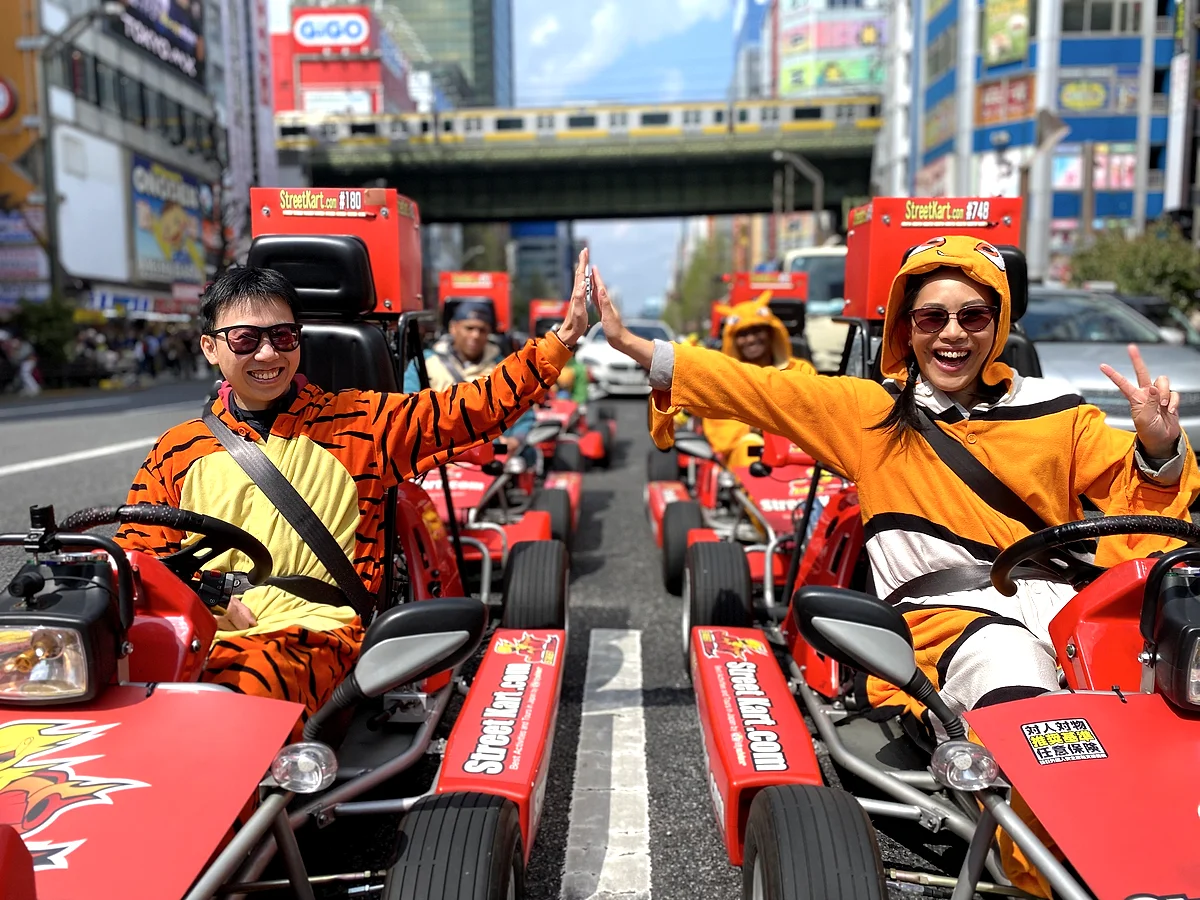
A wave of people surges forward. Beside them, a line of low-slung karts waits its turn.
The karts follow Japanese traffic laws and signals, along with the day's safety briefing and the guide's instructions. These rules are what today's article is all about!
Street karting means actually driving on ordinary public roads. Because you're on public roads, there are quite a few rules. If this is your first time in Japan, you might be worried: "What exactly do I need to follow?" "I have no idea what to expect when I get there."
But the rules aren't something to be afraid of. Once you understand why each rule exists, you'll feel much more relaxed on the day. In this article, we'll go through the safety approach used on Street Kart tours together, focusing on the differences between driving in daylight and driving after dark.
The First Thing to Know: This Is a Guide-Led Tour on Public Roads
Let's start with the most important point.
Street Kart's street karting is a tour that follows a set course for each store, led by a guide. It's not a free drive where you go wherever you like. The guide manages the route, so you won't leave the line partway through or change the route on your own.
Some people may feel this means "no freedom." But from a safety standpoint, it's a big reassurance. The guide at the front decides where to go, so participants can focus on following the kart ahead. You don't have to worry about getting lost in an unfamiliar city, and can put all your attention on driving.
The other key point is that because you're driving on Japanese roads, Japanese traffic rules apply as they are. For first-time visitors to Japan, here are the basics.
In Japan, cars drive on the left side of the road. If you come from a country that drives on the right, it's easy to drift into the opposite lane when turning at intersections. Be really careful here! That said, on the tour, the guide manages the route and leads the way.
Traffic light colors mean almost the same thing as in most countries. However, Japan has a lot of pedestrians, and pedestrians have the right of way at crosswalks. Stopping before a crosswalk is a basic duty for drivers. Also, drunk driving is strictly prohibited under Japanese law. Save the drinks for after your ride.
As for driver's licenses, there are detailed requirements, such as which types of licenses are accepted and whether you need an International Driving Permit. Before you go, be sure to check the driver's license page on the official website to confirm whether your license qualifies. If you don't have the required documents on the day, you won't be able to participate, and there are no refunds. Finding out on the day of your trip that "you can't drive with this license" is the saddest possible outcome.
The Flow of the Day, and When the Rules Come Up
To ease the worry of "not knowing what will happen," let's walk through everything from booking to departure in order.
Reservations are accepted via Facebook, LINE, email, and more. Check the official website for booking details. Weekends tend to fill up quickly, so if you want to ride on a Saturday or Sunday, we recommend booking early. Prices vary by season and time slot, so please check the official website for the latest rates.
On the day, take public transportation to the store. The stores don't have parking.
When you arrive, your license and identity will be checked, and then you'll move on to the pre-departure safety briefing. On tour day, guidance is basically in English. Guidance in Japanese or other languages depends on the staff that day and isn't guaranteed. If you're not confident in English, it's a good idea to check key points you don't want to miss, such as the meaning of hand signals and how to stop, with the official contact in advance. That way you'll feel more at ease.
The duration varies by store and plan. To avoid packing your schedule too tightly before and after, check the official website before planning your day.
Here's what we'd like you to remember: the pre-departure safety briefing covers how to operate the kart, the route, and important precautions. This is where you'll learn the basics of driving, such as "follow the guide's instructions" and "keep a proper distance from the kart in front."
If you don't understand something, ask right then and there. That's far safer than setting off without understanding. Asking just one question here makes a world of difference in how confident you'll feel once you're on the road!
How to Read the Rules in Daylight: A Tokyo Full of People and Cars
Now for the main topic: the differences by time of day. First, daytime.
Daytime in Tokyo is when there are lots of people and cars. Around the Shibuya Scramble Crossing and Omotesando, which the Shibuya and Shibuya Annex tours pass through, the sidewalks and crosswalks can be packed with people. The Akihabara Electric Town and Ginza areas on the Akihabara 1 and Akihabara 2 courses are also busy with shoppers during the day.
What you need to watch out for in daylight is the carelessness that comes from "seeing too much."
When the scenery is clearly visible, your eyes naturally drift to buildings and signs. The zelkova-lined avenue, rows of signboards, towering buildings. We get it, you want to look! But while you're holding the wheel, your eyes should basically be on the kart in front and the traffic lights. Enjoying the scenery while stopped at a red light, or while the line is moving along steadily, is just about right.
Another thing to watch for is delivery trucks and buses. In Japanese cities, vehicles carrying goods are often parked on the roadside. Karts sit low to the ground, so when passing a large vehicle, its driver may have trouble seeing you. That's exactly why staying in line, keeping your distance, and driving together as a group leads to safety.
Daytime rules are easy to understand if you think of them as "rules for being noticed by the people around you." Driving in a line and not changing lanes on your own both serve to make you a kart whose movements are easy to predict for other drivers and pedestrians. A kart whose next move is clear to everyone around it is safer for that reason alone.
How to Read the Rules After Dark: "Seeing" and "Being Seen"
When it gets dark, Tokyo's atmosphere changes completely.
The Rainbow Bridge on the Tokyo Bay course is lit up in seven colors at night. The Tokyo Bay store also offers evening time slots where you can enjoy the night view. On the Shinagawa course, too, you can see the Rainbow Bridge in the bayside area and Tokyo Tower in the distance.
A bridge of light spanning the dark water, and you're driving toward it. Just imagining it gets your heart racing. But after dark, the meaning of the safety rules shifts a little as well.
What you should be conscious of after dark is whether you can "see," and whether others can "see you." Even with streetlights and shop lights, bumps in the road and white lines are harder to spot than in daylight. You may also find it harder to judge the distance to the kart in front than during the day.
That's why at night, it's important to watch the guide's signals even more closely than usual. Things you can roughly figure out from your surroundings in daylight become harder to read in the dark, making the guide's movements your best clue.
Neon lights and illuminated signs can really lift your mood. But after bright light hits your eyes, dark areas can be hard to see for a moment. When moving from a bright area onto a dark road, use the kart in front as your marker and follow calmly.
At night, you'll also want to pay attention to how you're feeling physically. When traveling, there may be days when you head to a night tour after walking around all day. When you're tired, your attention drops more than you might think. If you're planning to ride at night, take it a little easier during the day and have a light meal before departure for peace of mind.
The time it gets dark varies by season, so there's no fixed rule for "what time counts as night." Once you've decided on your preferred time slot, check the official website for departure times and reservations.
Rules That Don't Change, Whatever the Time of Day
So far we've looked at the differences by time of day. But in fact, the rules that stay the same at any time of day are more important.
First: follow Japanese traffic laws and signals, along with the day's safety briefing and the guide's instructions. Whatever else you forget, don't forget this.
Second: don't touch your phone while driving. We completely understand wanting to take photos and videos! But while you're holding the wheel, focus on driving. Using a phone while driving is also prohibited under Japanese traffic law. The tour includes stops at photo spots, so follow the guidance on the day and enjoy taking pictures while stopped.
Third: don't race the other participants. Street karting isn't a race. You keep a safe speed and drive the set course in a line. Overtaking or speeding up disrupts the rhythm of the whole line and can lead to danger.
Fourth: plans may change depending on the weather. Depending on rain or wind conditions, the tour may be handled differently. The official website explains how different weather conditions are handled, so check before your trip and on the morning of your tour to avoid any last-minute panic.
The Appeal of Street Kart Lies Beyond the Rules
After all this talk about rules, let me finish by explaining why it's worth all this preparation to ride.
First, you get to see Tokyo's famous sights from street level.
Shibuya Scramble Crossing, the zelkova trees of Omotesando, the red-brick Tokyo Station, the streets of Ginza. Even places you've already seen on foot feel completely different when you look up at them from the low seat of a kart: the size of the buildings and the width of the roads. Familiar scenery starts to look like a city you've never been to. That's what makes it so irresistible.
Next, each store shows you a different side of the city.
There are seven stores in Tokyo, but Akihabara 1 and Akihabara 2, and Shibuya and Shibuya Annex, are each in nearly the same location. So rather than "seven areas," it's more accurate to think of it as seeing a different Tokyo from each store: the Shibuya/Harajuku area, the Akihabara/Ginza area, the Shinagawa area, and the Tokyo Bay area.
And finally, guides trained for international drivers lead the way.
Driving on unfamiliar roads in a country you've never visited. The guide driving just ahead of you shares that tension with you. The rules described in this article work precisely because there's a guide.
Here are a few numbers, too. As of November 2023, across all stores combined, there had been over 150,000 tours, over 1.34 million customers, and over 20,000 reviews, with an average rating of 4.9 out of 5.0. These figures are as of November 2023 and are not current. Even so, they show just how many people have driven this tour at stores across the country.
Also, the website is available in 22 languages. Note, however, that this applies to the website only. Guidance on tour day is basically in English, so keep those two things separate in your mind.
When You Can "Read" the Rules, the Day Is Even More Fun
In daylight, the rules are about being noticed in a Tokyo full of people and cars. After dark, they're about making up for reduced visibility. And regardless of the time of day, the basics are: follow Japanese traffic laws and signals, follow the day's safety briefing and the guide's instructions, focus on driving, and drive in a line without racing.
With all this sorted out in advance, the English briefing before departure should be much easier to follow: "Oh, this is that part." If anything is unclear, don't hesitate to ask on the spot.
First, check the driver's license page to see whether your license qualifies. Next, decide which store and time slot you'd like, and check how to book on the official website. If you want to ride on a weekend, booking early is recommended.
Finally, let's return to that Shibuya intersection from the beginning.
The light turns green. Your kart starts moving in the same rhythm as the one ahead.
With the rules in your head, there's no needless hesitation in that moment. All that's left is to savor Tokyo's streets to the fullest, right behind your guide.
Let's hit the road together!
This article was originally written in Japanese and translated using AI. Some expressions may read unnaturally, and we appreciate your understanding. For the most accurate and up-to-date information, please refer to the official site at kart.st.
Street Kart is not affiliated with Nintendo or the Mario Kart series in any way. We do not provide costumes of Nintendo characters, and such costumes may not be worn during tours even if brought by participants.