
Back to Street Kart in Tokyo with a Photo-Loving Friend: Shoot Before and After the Ride, with Photo Spots Across 4 Areas
Back to Street Kart in Tokyo with a Photo-Loving Friend: Shoot Before and After the Ride, with Photo Spots Across 4 Areas
Remember finishing your first tour, getting back to the hotel, and opening your camera roll?
You saw the views. The buildings, the sky, the intersections. But all you had to show for it was one selfie from before you set off. That's normal! You were gripping the wheel, following the kart ahead, and watching the traffic lights. It was your first time in Japan and your first time in Tokyo, and you were driving on the left. Of course photos went out of your head.
So if your photo-loving friend now says, "I want to come with you next time!", that's a good sign. The second time around, you already know how the tour works, so you'll have room to relax. Use that room for two things: really taking in the scenery, and planning the photos you'll take before and after the ride. This article is for people who have ridden Street Kart once and want to go again with a friend who loves photography. It covers how to approach the second trip and what each Tokyo location looks like. Let's start planning.
Keep shooting time and driving time separate
There's one thing to agree on first. While you're behind the wheel, you don't hold a camera. That's the promise.
Street Kart is a guided tour, and you drive on the same roads as regular cars, buses, bikes, and pedestrians. Japan drives on the left, and the traffic lights and pedestrian movement at intersections take some getting used to. Photographers especially may feel their hands reaching for the phone with an "Oh, look at that angle!", but using a phone while driving is dangerous, and we don't recommend it.
So what do you do while you're driving? It's simple: look, and remember.
If all you could manage the first time was following the back of the kart in front, you'll notice a lot more the second time. A tower suddenly showing up in the gap between two buildings. The sky opening up overhead the moment you reach a bridge. The wind on your face turning a little cooler than it was a minute ago. A camera can't capture those feelings. So take them in, and once you've finished, plan with your friend: "Could we shoot that bridge from the other side?" For me, that's the best part of a second ride.
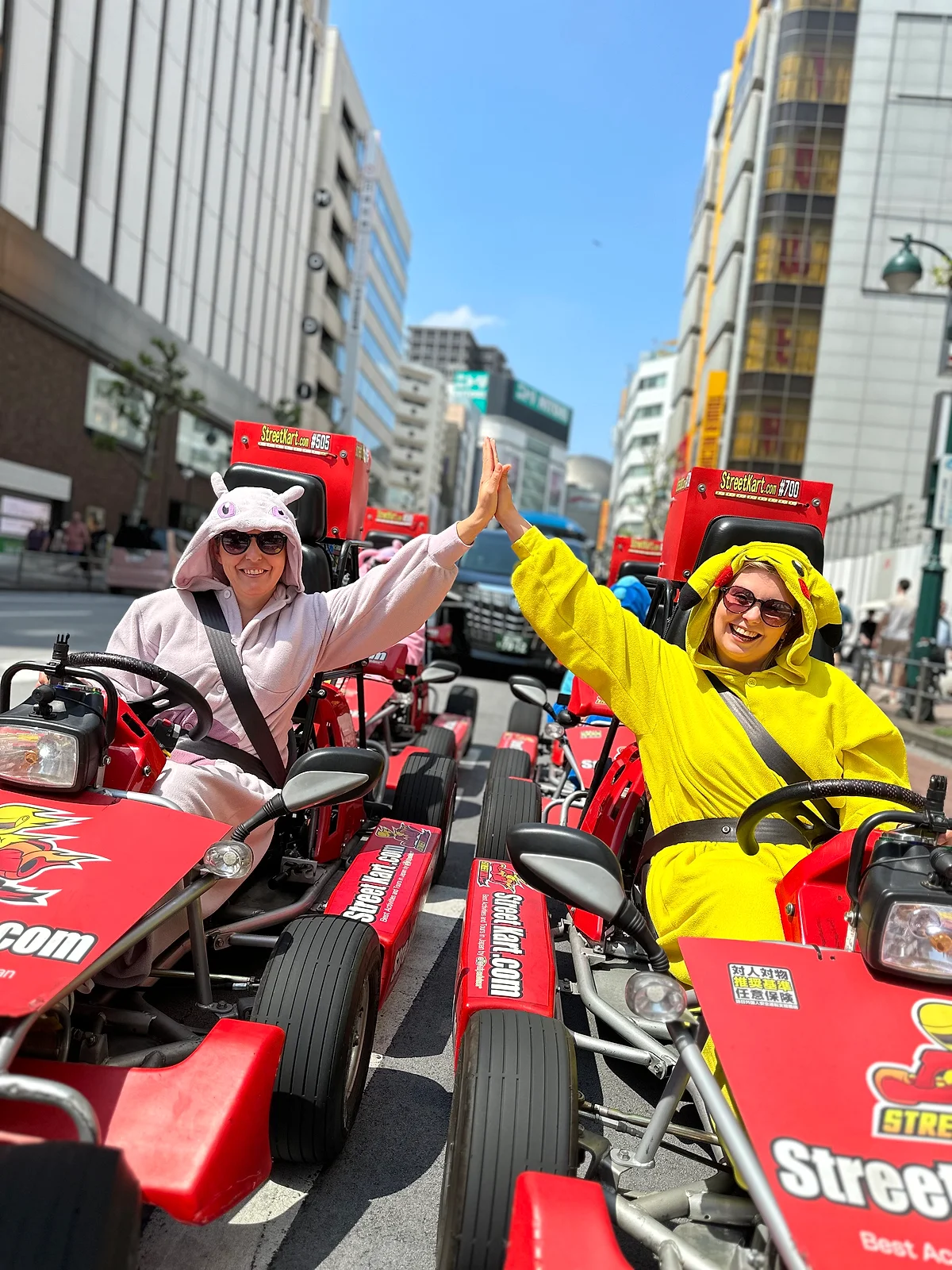
Splitting up roles helps too. In the 30 seconds before you set off, take each other's "before" shot in front of the shop. When you finish, take an "after" shot while you're still buzzing. Those two shots alone give you the first and last cuts of a short video. In CapCut or Jianying, cutting from a slightly nervous face before the ride to a big smile afterward is enough to make a story. Even if you ride a scooter or bike at home, driving a kart down Tokyo's big avenues is something else entirely. That difference shows up clearly in your faces before and after. Put them side by side and you might laugh.
There's one more trick for a second visit. Think back to your first tour: where did you wait at red lights, and where did the sky open up? Your memory of the route makes useful location scouting for your photographer friend. If you tell them ahead of time something like "From the sidewalk, that intersection probably looks like this," the photo walk after the tour will go much more smoothly.
If you're adding photo walks before and after the ride, think about your phone battery too. A common mistake is shooting a lot before the ride and then running out of battery at the very time you most want to take pictures after the tour. Put a power bank in a small bag and you won't have to worry.
What photographers will love at each location
Street Kart has seven locations in Tokyo. But Akihabara Shop 1 and Shop 2 are in almost the same place, and so are the Shibuya shop and Shibuya ANNEX. So you're not choosing between seven completely different neighborhoods. Here, we group them into four areas by the kind of scenery you'll see. Pick a different area from last time, and your second tour will feel like a whole new trip.
Each location has its own set course. Check the official website for details on the route. The "places to visit before and after the ride" below are spots you'll go to on foot, outside the tour. Please keep them separate from the course you drive.
Shibuya and Shibuya ANNEX: Shoot the Scramble Crossing from above
The scenery listed for the Shibuya courses includes the Scramble Crossing, the zelkova trees along Omotesando, and the area around Takeshita Street in Harajuku. You drive yourself right through the middle of a city surrounded by buildings.
Have your photographer friend shoot "Shibuya from above" before or after the tour. The Scramble Crossing is about a 10-minute walk from the shop, and the second floor of Starbucks and the rooftop of MAGNET are known spots for looking down on it.
Picture the crossing for a moment. During the red light, people pack the sidewalks at all four corners. The moment the light turns green, the crowds spread out from every direction at once, flowing straight across and diagonally too. It's said that up to 3,000 people cross at once. From above, it looks like a tide coming in. Blur the moving crowd with a slower shutter speed, and you'll get a shot that's pure Shibuya.
If you want to see the whole city from even higher up, head to Shibuya Scramble Square, about a 10-minute walk from the shop. At 230 m, it's the tallest building in Shibuya, and it has an observation deck called Shibuya Sky. Shoot the sky changing color at dusk, then drive the streets on the tour. The city seen from above and the city seen from a kart's low angle: you can get two sides of the same Shibuya in one day.
The Hachiko statue is also about a 10-minute walk from the shop. It's a famous meeting spot, so of course it's crowded. Many people in Japan don't like having their face clearly photographed, so avoid shooting strangers head-on. If you can walk a bit more after the tour, Meiji Jingu is about 20 minutes away on foot. Past the giant torii gate is a deep forest you'd never expect in central Tokyo, and the quiet after driving through the city of buildings comes through in your photos.
The two Akihabara shops: Electric Town signs and an old Edo shrine
The scenery listed for the Akihabara-area course includes Akihabara Electric Town, the red-brick Marunouchi Building of Tokyo Station, and the streets of Ginza. There's Tokyo Station's building, opened in 1914, and there's Electric Town, packed with signs. On one tour, it feels like you cross 100 years of Tokyo. I think that's even more fun the second time, when you have room to take in the views.
Once you've taken in the red-brick station building on the tour, it's also a good plan to come back another time to photograph it properly. Tokyo Station is about 5 minutes from Akihabara by train. The front on the Marunouchi side is a popular photo spot. The building is very wide, so you can either step back with a wide-angle lens to fit it all in, or move in close for the windows and decorations. Try shooting it alongside your friend. It's interesting how differently two people see the same building.
After the ride, another good plan is to walk through the Electric Town you just drove through and head to Kanda Myojin, about a 10-minute walk from the shop. This shrine has 1,300 years of history and has long been seen as a guardian of Edo. You go from the city of signs you saw from behind the wheel to the front of a torii gate on foot, following on from the road you drove, this time with a camera. Even where photos are allowed, shoot from a spot where you won't get in the way of people praying.
If you want to shoot the Electric Town signs, go after sunset when they start to light up. Add a little blue in VSCO and you'll get a strong cyber feel.
Shinagawa: High-rises and Tokyo Tower in the distance
The scenery listed for the Shinagawa course includes the high-rises around Shinagawa Station, the Takanawa area, the Shibaura and Tamachi bay area, and Tokyo Tower and the Rainbow Bridge in the distance. Shinagawa is all about switching back and forth between straight-lined office towers and the open sky of the waterfront.
The Shinagawa shop is about a 3-minute walk from Kitashinagawa Station on the Keikyu Main Line, and about 10 minutes on foot from Shinagawa Station. If you're walking with a camera before or after the ride, head to Shinagawa Shrine, about 5 minutes from the shop. Its grounds have a Fujizuka, a small mound built to look like Mt. Fuji. About 10 minutes away on foot is Honsenji Temple, with a great temple bell listed as a Tangible Cultural Property of Tokyo. On the tour, if you see Tokyo Tower beyond the buildings, remember where you saw it. After the ride, it's your turn to go photograph it up close. A popular shot is looking up at it from near Shiba Park. You saw the 333 m red-and-white tower far off from the low seat of a kart, and now you look up at it from right below. Put the far shot and the close shot side by side with your friend.
Tokyo Bay: The waterfront and the Rainbow Bridge
The scenery listed for the Tokyo Bay (Shin-Kiba) course includes the Rainbow Bridge, Odaiba, Tokyo Tower in the distance, and the Shin-Kiba bay area. The 798 m suspension bridge lights up in seven colors at night. Instead of driving between buildings, you drive along a waterfront with a wide-open sky. If your first ride was at one of the central city shops, this one should feel fresh.
The shop is about an 8-minute walk from Shin-Kiba Station. The station has a café and restaurant called CASICA, which works well as a meeting spot before your ride. After the tour, you could also plan to photograph the Rainbow Bridge from the Odaiba side.
If you two can get going early, you could have breakfast at Toyosu Market first and then head over. Both Odaiba and Toyosu Market are a bit far from the shop, so check how to get there before you add them to your plan. A shot of a seafood bowl from directly above is one your photographer friend surely won't miss. If you want to catch the bridge lit up, check the official website first to see whether there's a tour in the evening, then make your plan. If you want to use a tripod, it's also smart to check ahead whether tripods are allowed where you'll be shooting.
Steps to go over again, from booking to the day of the tour
It may be your second time, but it's your friend's first. To help with their "I don't know what to expect" worries, go through the steps together.
To book, get in touch through Facebook, LINE, or email (booking@streetkart.com). Weekends fill up fast, so once your dates are set, book early. Tour length and start times depend on the course, and prices vary by season and time of day. Check the Street Kart official website (kart.st) for the latest information.
Tell your friend about the language of the tour too. On the day, guidance is basically given in English. Guidance in Japanese or other languages depends on the staff that day and isn't guaranteed. If you want guidance in another language, it's safest to ask ahead of time. The website is available in 22 languages, but that's separate from the guidance on the tour itself. The site's languages include Traditional Chinese, so it's a good idea to read it with your friend before you go.
This next part is worth stopping to check carefully. Just because your license worked last time doesn't mean your friend's will. The documents you need depend on your country and the type of license. You need the original paper license, and digital licenses can't be used. If you don't have the right documents on the day, you can't join the tour, and you won't get a refund. Read the official website's guidance on licenses together with your friend before you go.
On the day, the shops have no parking, so take the train or other public transportation. Trains in Japan usually run on time, but transfers at big stations can take longer than you'd expect. If it's a station you don't know, leave with time to spare. There are convenience stores near every shop, and you can use their ATMs.
Talk about the weather with your friend as well. In light to moderate rain, the tour goes ahead as planned, and raincoats are provided free of charge. Tours are canceled in heavy rain or typhoons. If you're bringing camera gear, put a waterproof cover or a plastic bag in your bag in case of sudden rain. Tokyo after the rain, with city lights reflecting on wet streets, makes for a very different subject than on a sunny day.
If your friend is bringing camera gear, have them check with staff before setting off about how to handle it, such as where larger equipment can be kept. The shops have lockers for small items, but they aren't suited to large bags. The worst outcome is worrying about your gear while you drive and not being able to focus on the road. Shoot before and after the tour. While you're driving, enjoy the views for what they are. If you can make that switch, your second Street Kart ride should leave a much more vivid memory than the first.
The first time was the day you shouted, "I did it!" The second time is the day you look at Tokyo with a photo-loving friend, remember it, and go back to shoot it.
Once you've chosen your area, check the official website first, then get in touch to book through Facebook, LINE, or email. Next time you open your camera roll, you'll find one shot from before the ride and one from after. There are no photos in between because you decided not to shoot while driving. But that gap still holds the Tokyo wind you two felt together.
This article was originally written in Japanese and translated using AI. Some expressions may read unnaturally, and we appreciate your understanding. For the most accurate and up-to-date information, please refer to the official site at kart.st.
Street Kart is not affiliated with Nintendo or the Mario Kart series in any way. We do not provide costumes of Nintendo characters, and such costumes may not be worn during tours even if brought by participants.