
Drive a Kart Through Shibuya, Tokyo, and Watch Your Friend's Face Change: Seeing the City Through Your Companion's Reactions
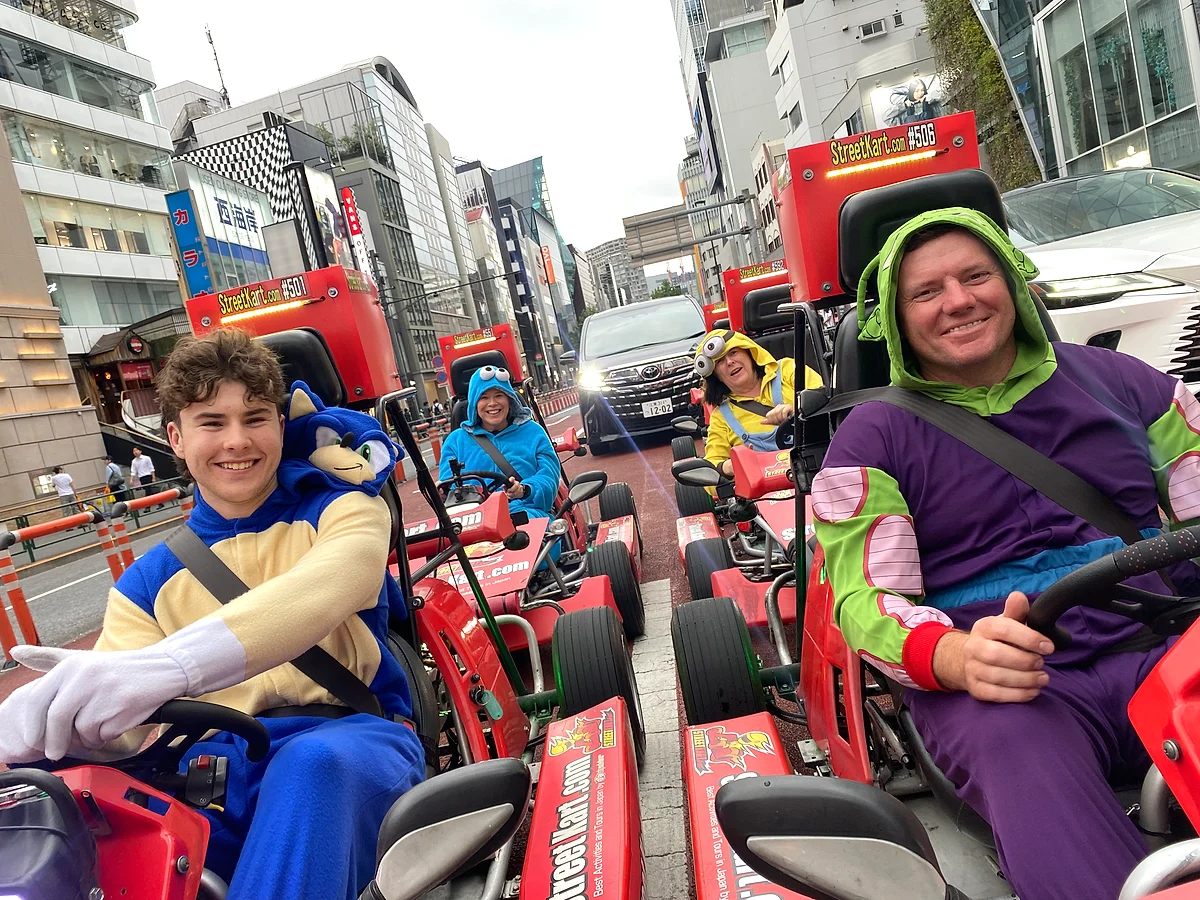
Drive a Kart Through Shibuya, Tokyo, and Watch Your Friend's Face Change: Seeing the City Through Your Companion's Reactions
You're in front of the shop, about to set off.
Your friend, already sitting in the kart next to you, turns to look at you. They don't say anything yet, but their eyes do: "Wait, we're seriously driving here?!"
When you drive a street kart through Shibuya, Tokyo, you see more than the city. The person who came with you looks completely different after the ride than they did before it. In this article, we'll use those "companion reactions" as our guide to the many faces of Shibuya. If it's your first time in Japan and you're bracing yourself because you don't know what to expect, we'll also work through those worries one at a time before you go. Ready? Let's go!
Easing the "Is This Really Okay?" Before You Set Off
Invite a friend who's visiting Japan for the first time, and you may hear "Is that safe?" before you hear "Sounds fun!"
That's completely natural. They'll be steering through unfamiliar streets in a country they don't know, so it would be strange not to feel a little scared. That's exactly why this worry deserves a real answer instead of being laughed off.
First, the basics: in Japan, cars drive on the left side of the road. If you come from a country that drives on the right, like Taiwan, mainland China, South Korea, or the United States, this is where you're most likely to feel confused. When you turn at an intersection, your body may want to drift toward the wrong side.
On a Street Kart tour, though, a guide drives in front and participants follow behind. You don't choose your own route. Each shop has a set course, and the group drives it in a line behind the guide. If you explain this setup ("you stay on a set route and follow the person in front of you") ahead of time, your friend will probably relax a little.
The other big worry is language. Tour guidance on the day is basically in English. Whether guidance is available in Japanese or other languages depends on the staff working that day, so it can't be promised. If you're not confident in English, contact Street Kart through the official website beforehand. The website is available in 22 languages, including Traditional Chinese, so a friend from Taiwan can read up on the Traditional Chinese pages before coming.
What to Know Between Booking and Tour Day
The very first thing to check is your driver's license. Please, please don't skip this step!
Which licenses are accepted involves some rules specific to Japan, so be sure to check the Street Kart official website before you leave home. You'll find the details there. If you come to Japan without checking, you might not be able to ride on the day. Standing outside the shop waving goodbye to everyone else would be a sad way to spend part of a long-awaited trip.
Bookings are accepted via Facebook, LINE, and email. Contact details are on the Street Kart official website. Weekends fill up quickly, so once your travel dates are set, book early. You might get excited mid-trip and say "Let's go this weekend!" only to find there are no spots left.
Tour length and departure times vary by plan, so they aren't listed here. Check the official website before you put your itinerary together.
One more thing about Japanese customs: being on time is taken very seriously in Japan. Check the meeting time in your booking carefully and give yourself plenty of time to get there. The shops don't have parking, and roads around Shibuya are often congested, so the train is a more reliable choice than a car or taxi. The Shibuya shop and Shibuya Annex are about a 10-minute walk from Shibuya Station, or about 5 minutes on foot from Shinsen Station on the Keio Inokashira Line. Shibuya Station's transfer passages are a maze, so allow some time for getting lost and you'll feel more relaxed. There's a convenience store within a 5-minute walk of the shop, so you can grab a drink or withdraw cash from a convenience store ATM before setting off.
How Does Your Companion's Face Change the Moment You Start Driving?
Now for the main event!
The moment your friend sits in the kart, they'll probably laugh, because it's much lower than they expected.
Let me take a moment to describe this. The road is right under your seat. The tires of a bus pulled up beside you are at eye level. There's no roof and no windows, so every sound comes straight to your ears: footsteps on the sidewalk, the voices of people passing by, the chime of the crossing signals. The wind hits your face head-on, and the engine's fine vibrations travel through the steering wheel into your palms.
If someone asked what makes karting such a thrill, this would be my answer. It isn't the speed. It's the feeling of having no distance at all between you and the city.
Many people in Taiwan are used to getting around town by scooter (機車), but a kart sits much lower. Both are open-air vehicles, yet you look up at the city from a completely different angle. It's so low that at the first red light, your friend might say, "這個視角太扯了" ("This view is unreal").
"Wait, We're Driving Here?!" at the Scramble Crossing
The landmarks listed for the Shibuya shop's route include the Shibuya Scramble Crossing, the famous intersection where as many as 3,000 people are said to cross at once.
Normally, this is a place you watch: you stand near the Hachiko statue or SHIBUYA109 and observe the crowds flowing past. From the low seat of a kart, it shows you a completely different face.
The pedestrian light turns green, and people start moving from all four directions at once. Seen from the roadway, that flow stops being scenery. It's a wave of people moving right in front of you!
Your companion's reaction will probably go one of two ways: they'll freeze, eyes wide, or they'll find themselves waving back. Tourists on the sidewalk may notice the karts and point their phones at you. A moment ago you were the ones taking pictures, and now you're the ones being photographed. To put it mildly, that reversal hits you right in the feels.
All around stand high-rises built during Shibuya's redevelopment, such as Shibuya Hikarie, Shibuya Scramble Square, and Shibuya Stream. From down low, their glass walls seem to stretch all the way into the sky. You're looking up at Shibuya, a city that never stops changing, from the lowest possible vantage point.
Now, one important promise: don't touch your phone while driving. I completely understand wanting to take pictures! But while your hands are on the wheel, keep your focus on driving. Take photos before you set off and after you finish. Check your friend's expression before and after too. To find out how they felt during the ride, ask "Where were you most surprised?" once you're back at the shop, and look back on it together. That conversation becomes your souvenir of the day.
Why Voices Change Tone Around Omotesando and Harajuku
Once you've left the bustle of the crossing behind, the route materials list places like Omotesando, Harajuku, and the areas around Yoyogi Park, Meiji Jingu Shrine, and NHK Hall.
Omotesando is a broad avenue lined with zelkova trees. Along both sides stand distinctive buildings designed by famous architects, along with Omotesando Hills and Tokyu Plaza Omotesando Harajuku. In contrast to the wave of people in front of Shibuya Station, here the branches spread overhead and the air feels calmer. A companion who was shouting at the crossing may switch to a quiet "Wow..." here.
As you approach Harajuku, the energy shoots right back up! Known as the birthplace of kawaii culture and street fashion, the neighborhood throws one colorful shopfront after another at you. Around Meiji Jingu Shrine and Yoyogi Park, you'll see an amount of greenery that's hard to believe in the middle of the city. The Meiji Jingu forest covers about 700,000 square meters. When you suddenly sense a forest between the buildings, someone will probably say, "I didn't know Tokyo had this side to it."
You're only driving around Shibuya, yet the city keeps changing: clusters of towers, a tree-lined avenue, a fashion district, a forest. Every time it changes, so does the reaction of the friend next to you. Ask afterward, "Where were you most surprised?" and everyone gives a different answer. That's one of the best parts of the experience.
The same streets look different in daylight and after dark. As the lights from buildings and signs come on, Shibuya turns into what feels like another city. You could choose your booking time based on which Shibuya you want to see. Check the official website for departure slots.
What Makes Street Kart Appealing
Let's take a moment to talk about Street Kart itself.
First, its track record. As of November 2023, across all shops combined, Street Kart had run more than 150,000 tours, served more than 1.34 million customers, and received more than 20,000 reviews, with an average rating of 4.9 out of 5. Numbers don't tell you everything, but the fact that so many people have explored the city on these tours is a useful indication.
Second, its locations. There are 9 shops nationwide: 7 in Tokyo and 1 each in Osaka and Okinawa. The 7 Tokyo shops include some that are almost in the same spot, such as the Shibuya shop and Shibuya Annex. Besides Shibuya, there are shops in Akihabara, Shinagawa, and Tokyo Bay (Shinkiba), each covering a different area. Once you've driven Shibuya, you can explore a different part of the city on your next trip.
And finally, you get to share the same moments with your companions. The karts are single-seaters, so everyone takes their own wheel. Even so, you stop at the same lights, pass through the same intersections, and yell "Whoa!" at the same moment. Nobody is just riding along behind someone else. Everyone is part of the action, driving with their own hands!
After the Ride, Walk Shibuya Again
When you're done driving, try visiting the places that caught your eye, this time on foot. This is where your friend's reactions come in handy: "I want to see that crossing from above!" "I want to walk down that tree-lined avenue!" The places you sped through by kart become your next destinations.
The Scramble Crossing is about a 10-minute walk from the shop. For a view from above, the second floor of the Starbucks in front of the crossing and the rooftop of MAGNET are well-known photo spots. Now you're looking down on the same road you were just driving on. A photo taken while pointing and saying "We were right down there a minute ago!" means something completely different from an ordinary shot of the crossing.
If you want to go even higher, head to Shibuya Sky, the observation deck at the top of Shibuya Scramble Square (a 10-minute walk from the shop). From the top of the 230-meter tower, it's fun to look for the roads you just drove. Omotesando is about a 15-minute walk from the shop. Walk under the zelkova trees you looked up at from the kart, this time on your own two feet.
When you get hungry, Dogenzaka Ramen Yokocho is about 8 minutes on foot from the shop, and Ichiran Shibuya is about 10 minutes away. Some ramen shops in Japan have you buy a meal ticket from a vending machine at the entrance, which can confuse first-timers. If you can't read the kanji on the machine, the camera feature of a translation app on your phone will help. If you use Traditional or Simplified Chinese, you can sometimes guess what the Japanese kanji mean, which is a nice little bonus. If you'd rather have coffee, Blue Bottle Coffee Shibuya is about a 10-minute walk away, a good place to let the excitement settle.
If you're posting on social media, try putting a photo from in front of the shop before the ride next to one at the crossing afterward. The "so excited for this" face beside the "we did it" face will probably be your best post. For hashtags, why not use the Japanese #渋谷 and #東京旅行 along with the Chinese #澀谷 and #東京自由行?
On Your Next Trip to Tokyo, Go See the Person Next to You Try Something for the First Time
Shibuya is a fun city whether you explore it on foot or look down on it from somewhere high up.
But when you race through it with someone beside you, just above the pavement, their face stays in your memory as vividly as the city does. The shouts at the crossing. The quiet "wow" on the tree-lined avenue. And after the ride, "I want to go again!"
Start with three steps. First, check the license requirements on the official website. Second, book via Facebook, LINE, or email. Weekends fill up fast, so book early. Third, on the day, take the train to Shibuya and leave yourself plenty of time.
The latest information, plans for each time slot, and booking contacts are all on the Street Kart official website.
So, who will you invite on your next trip to Tokyo? Once you decide, your adventure begins. The light's about to turn green!
This article was originally written in Japanese and translated using AI. Some expressions may read unnaturally, and we appreciate your understanding. For the most accurate and up-to-date information, please refer to the official site at kart.st.
Street Kart is not affiliated with Nintendo or the Mario Kart series in any way. We do not provide costumes of Nintendo characters, and such costumes may not be worn during tours even if brought by participants.